
Unravelling hyperglycemia in diabetic cardiomyopathy

Complex diseases are driven by dynamic interactions between multiple biological layers, including molecular signalling, metabolism, inflammation, cellular stress responses, epigenetic regulation and tissue-level dysfunction. Their progression is rarely explained by a single pathway, but rather by the coordinated dysregulation of interconnected mechanisms that evolve over time and may vary across patients.
In this context, systems biology and computational modelling provide a powerful framework to organise biological knowledge, formalise disease mechanisms and generate testable hypotheses. By transforming static information from literature and omics data into executable mechanistic models, these approaches can support the exploration of disease progression, the identification of key regulatory nodes and the prioritisation of therapeutic strategies in silico.
Date: 6th July 2026
Our Aixial innovation team is developing a broader mechanistic modelling framework dedicated to complex and multifactorial diseases, with several complementary disease models currently under development across different pathological contexts. The present work focuses on diabetic cardiomyopathy as a clinically relevant use case to demonstrate how knowledge-driven and data-driven approaches can be combined to build dynamic disease models and evaluate potential therapeutic interventions.
The largest static network and multivalued dynamic model of diabetic cardiomyopathy
Diabetic cardiomyopathy (DbCM) is an increasingly recognised complication of diabetes that contributes to cardiac dysfunction and heart failure. Its pathophysiology involves complex interactions between metabolic, inflammatory, molecular and cellular processes, making the identification of effective therapeutic targets particularly challenging.
To address this complexity, we developed a computational framework integrating current biological knowledge and genomic data into a comprehensive mechanistic model of DbCM. We first constructed a large-scale, literature-based and SBGN-compliant knowledge base describing the molecular mechanisms involved in disease progression, comprising 480 components and 430 reactions. This static representation was then converted into a dynamic multi-valued model including 381 nodes and 541 interactions, enabling the simulation of complex DbCM-related pathological processes.
The model is designed to reproduce key pathological behaviours observed in diabetic cardiomyocytes and to simulate the effects of progressive hyperglycaemia on disease-associated phenotypes. It provides a virtual environment to explore disease-driving mechanisms and evaluate potential therapeutic perturbations, including pharmacological and microRNA-based strategies.
In the current in silico simulations, metformin alone shows modest effects on several downstream pathological phenotypes, while combined metformin and microRNA-based perturbations are predicted to more strongly attenuate multiple DbCM-associated alterations. In the model, combined strategies appear to reduce several features associated with disease progression, including inflammation, mitochondrial dysfunction, myocardial hypertrophy, myocardial fibrosis, microvascular disease and the global diabetic cardiomyopathy phenotype.
Overall, this work provides a systems-level representation of diabetic cardiomyopathy and establishes a mechanistic foundation for the in silico evaluation of therapeutic strategies. Beyond DbCM, it illustrates the potential of reusable computational pipelines to support the study of complex diseases characterised by multi-scale and multifactorial dysregulation.
Scientific poster spotlight
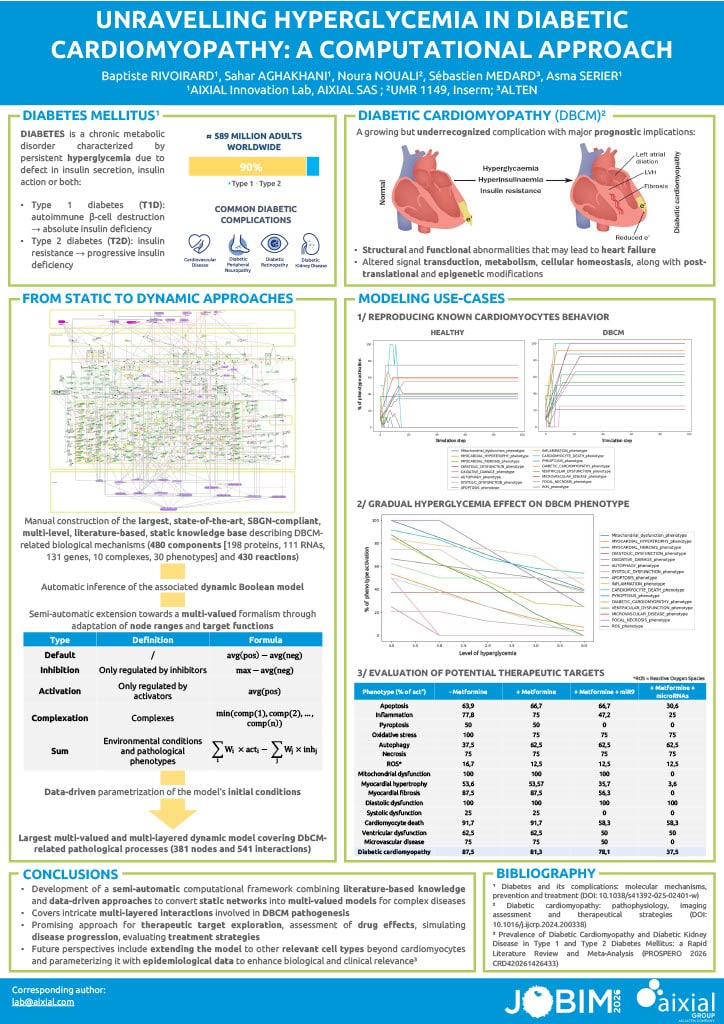
This model represents one application of a broader team strategy aimed at progressively building a portfolio of mechanistic disease models. Several models are currently being developed within the team, with the objective of creating reusable, extensible and biologically interpretable frameworks that can be adapted to different disease areas, enriched with patient-level data and used to explore disease progression, treatment response and target prioritisation.
Future developments will focus on extending this modelling strategy beyond diabetic cardiomyopathy to other diabetic complications, with the aim of progressively building a portfolio of mechanistic models covering diabetes-related pathological processes. These models will be enriched with clinical, omics and epidemiological data and used to support therapeutic hypothesis generation, drug repositioning, target prioritisation and precision medicine approaches across complex diseases.
TO GO FURTHER





How can we support your next project?
Whether you’re looking for a protocol review or a proposal,
simply reach out to us by filling our request for proposal.