Anticipating regulatory changes for medical devices

The evolution of a regulatory framework results from dynamic interactions among numerous factors: the state of scientific and technical knowledge, developments in the sector, reported incidents, emerging innovations, public health needs, institutional positions, and challenges observed in the application of existing regulations. It generally cannot be explained by a single factor, but rather by the gradual convergence of diverse and interconnected signals, the intensity and timing of which vary from one sector and jurisdiction to another.
In this context, text analysis, network modeling, and machine learning provide a powerful framework for structuring regulatory information, formalising the mechanisms of regulatory change, and generating testable hypotheses. By transforming heterogeneous documentary sources into actionable representations, these approaches make it possible to study the dynamics of text emergence, identify factors that may signal an upcoming change, and assess the feasibility of anticipating such changes prior to their publication.
Date : 10 september 2026
Aixial’s Innovation Team is currently developing a framework for analyzing and modeling regulatory changes in the healthcare sector. One focus of this work, conducted in collaboration with the FEMTO-ST Institute (AS2M department) as part of a CIFRE thesis, is the European regulatory framework, with a particular focus on medical devices, which serve as a case study to illustrate how heterogeneous contextual data can be combined to model and ultimately anticipate regulatory changes.
A structural discrepancy between innovation and its legal framework
To enter a market, manufacturers must demonstrate that their devices meet the regulatory requirements of the relevant jurisdiction: authorisation obtained in Canada does not constitute compliance with the European regulatory framework. Any change to this framework therefore alters the conditions under which a product can be developed, certified, or kept on the market. A relaxation of regulations facilitates the entry of new devices, whereas stricter requirements can jeopardise products already on the market.
However, these requirements apply to products whose development takes a long time. Between the conception of a device and its launch on the European market, two to six years elapse or even longer depending on the nature of the product, its risk level, the required testing, and the conformity assessment procedure. Added to this is the time needed to achieve economic viability. Throughout this entire period, the legal framework itself may change.
The MDR illustrates this trend. Proposed by the European Commission in 2012, adopted in 2017, and gradually phased in, it has strengthened conformity assessment requirements and modified the conditions for designating notified bodies. The initially limited capacity of these bodies, combined with the increase in the number of devices requiring reevaluation, has contributed to creating a bottleneck in certification procedures. The consequences are not only industrial or financial: they also affect healthcare facilities and professionals and ultimately patients by limiting or delaying access to necessary medical devices.
That leaves the question of the next step: What requirements will apply to the technologies of the future, over the next five to ten years?
From reactive monitoring to predictive monitoring
The field of RegTech encompasses the methods and technologies used to facilitate the understanding, monitoring, and enforcement of legal and regulatory requirements: automated monitoring, conversational systems, comparative analysis of legislation, prediction of litigation outcomes, and estimation of the probability of a bill’s passage. However, these approaches come into play only after a bill has been published or when it has reached an advanced stage of deliberation.
This project aims to shift this monitoring process from a reactive or anticipatory approach to a proactive and predictive one. It is based on the observation that legislative texts alone are not sufficient to reliably anticipate regulatory changes. Modeling medical device regulations and identifying factors that may signal a change therefore requires incorporating contextual data.
An eight-step framework, from data to validated predictions
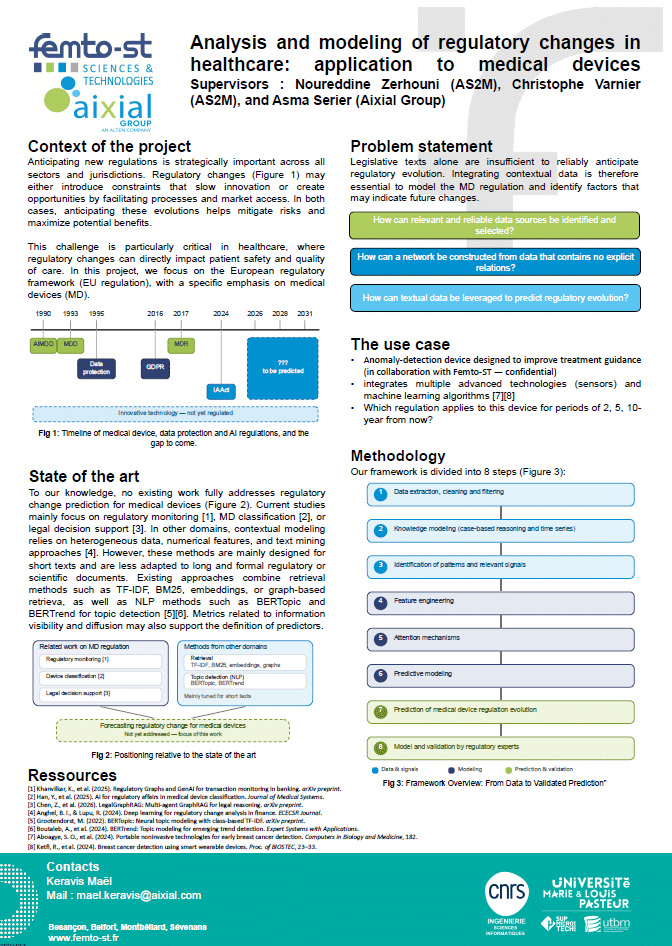
The proposed methodological framework consists of eight steps, divided into three phases. The first phase involves processing the raw data: data extraction, cleaning, and filtering; knowledge modeling; and the identification of relevant patterns and signals. The second phase transforms the data into a model by combining attention mechanisms and predictive modeling. The third phase generates predictions regarding regulatory changes and submits them to regulatory experts; their validation will confirm the model’s performance.
Ultimately, the project aims to characterise the environment of a sector, identify factors likely to influence regulatory action, and estimate the probability of new regulatory directions emerging. For manufacturers, such an approach would make it possible to prepare their development, compliance, and market access strategies earlier, and to limit the risk of disruptions or delays in making devices available to patients.
Spotlight on the scientific poster
As part of this research collaboration, a scientific poster was presented at a FEMTO-ST laboratory seminar to communicate the project’s objectives and the associated scientific challenges. It was also showcased to company colleagues who were not directly involved in the project, providing valuable opportunities for discussion and feedback within the multidisciplinary environment of the Innovation Directorate.
Beyond its scientific and regulatory significance for stakeholders across the sector, this project forms part of a continuous improvement approach aimed at benefiting patients and end users. By contributing to the optimisation of medical device development and market access strategies, it supports the emergence of more innovative, safer, and more accessible solutions. This collaboration therefore highlights the added value of bringing together academic research and industrial expertise to address the healthcare challenges of the future.
TO GO FURTHER






How can we help you with your next project?
Whether you’re looking for a protocol review or a collaboration proposal
Our team is available to discuss your needs with you.