A 120-km ultra-trail, one stride at a time
Our employees’ stories – Felix Collet
Date: October 20, 2026
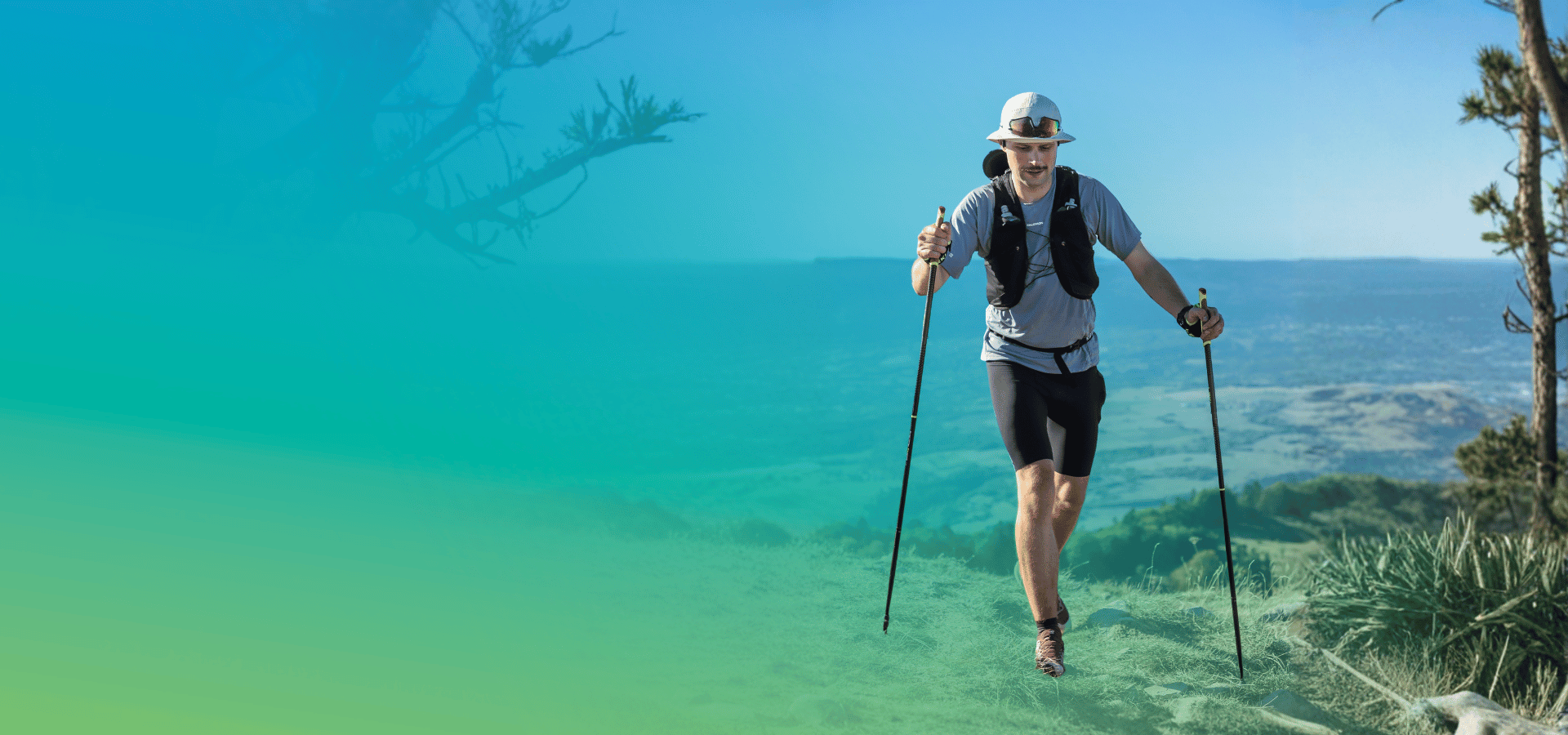
“When I reached the summit, something just clicked. Physically, I was feeling better, but more importantly, mentally, I knew I was going to make it. At the next aid station, I looked at my dad and told him, ‘I’m going to finish this race.’ From that moment on, in my mind, it was a done deal. Unless I got injured, nothing could stop me.”
Felix Collet
Can you introduce yourself and tell us about your role at Aixial?
— Hi, I’m Félix, and I’ve been a clinical project manager at Aixial since January 2024, based in the Lyon office. I have a master’s degree in pharmaceutical sciences and have been working in clinical trials for seven years now. I started my career as a clinical research associate before gradually moving into project management.
Where does your passion for trail running come from, and what motivated you to take on a 120-km challenge?
— I’ll be honest: it’s all kind of my little brother’s fault!
I watched him rack up the kilometers and complete races that kept getting longer and longer. At first, I was in awe. Then, pretty quickly, I thought to myself, “Wait… why can he do that and I can’t?” Yet I was going through a period of extreme inactivity: I hadn’t done any sports at all since the birth of my two little girls—about three years ago. Being a dad is complicated enough on its own. So I eased back into it gradually, always making sure to maintain a balance between my family life, work, and exercise.
Beyond this little brotherly rivalry, trail running is the union of nature and running. Nothing could be easier than going for a run: just a pair of shoes, and off you go! And to break up the monotony of running on pavement, there’s nothing like getting away on the trails—in the woods, in the mountains, or elsewhere. What I love about the “ultra” aspect of trail running is that it turns every race into a true “adventure.” I’m lucky to have a dad who’s always encouraged and supported us in our races, no matter what they are. So for him, helping out at the aid stations has become his “national sport.” He worries about how I’m doing and hopes I’ll be able to hang in there… There isn’t always cell service along the courses, so not knowing if he’ll make it in time for the next aid station is super stressful for him.
So, in the end, it’s not just a solo race—there’s a whole lot of logistics involved. It’s that aspect—the sense of community and sharing—that leaves a lasting impression, creates memories, and gives trail running that true sense of “adventure.”
To get back to the question of why a 120-km challenge: I was simply looking for my first big race to test my limits, and as an aside, the UTGC wasn’t originally in the plans. I was registered for another race that same weekend, which ended up being canceled due to a lack of participants. Feeling really down, it was a colleague—who will surely recognize himself—who suggested this alternative to me, which just goes to show that everyone is getting involved in this project to a greater or lesser extent.
How did you prepare for such a challenge, both physically and mentally?
— I got back into running seriously in May 2025 with the goal of competing in the SaintéLyon (an 80-km night race). The first 50 kilometers went pretty well, but the last 30 were absolute hell. I finished by gritting my teeth and limping along, solely because I was determined to cross the finish line.
After the race, I was sore all over. It took me a long time to recover, and I even had to see a doctor because of persistent knee pain related to a previous patella fracture. At that point, I was really down in the dumps because I thought that with this pain, I’d never be able to run longer distances and that I’d reached my limit.
I had this doubt in the back of my mind that I absolutely had to clear up, so—very cleverly—I told myself I needed to aim for a 100-km race, but… 100 km is old hat, so I decided to skip that step and go straight to the 120-km mark. Brilliant, isn’t it?
To give myself the best possible chance, I enlisted the help of a coach—who is also a physical therapist—to structure my training. We developed a customized program with plenty of strength training and a special focus on my knees. Over the months, my training volume gradually increased. Little by little, I went from two to four to five runs a week, sometimes covering up to 120 km.
The hardest part wasn’t even the physical strain—it was figuring out how to fit it all into an already busy schedule. Between work, family life, and training, I had to stay organized. Nearly 90% of my workouts took place between noon and 2:00 p.m. Some people get in their cars to go somewhere; I just laced up my sneakers.
During the race, what was the hardest part, and how did you manage to get through it?
— Without a doubt, between the 60th and 80th kilometer.
The first 60 kilometers went perfectly—I was running at the right pace, my nutrition was going well, and I wasn’t feeling any pain. I was running with another participant; we chatted, the pace was good, and our spirits were high.
And then came that infamous stretch between two aid stations on a long, seemingly flat stretch. On paper, I was supposed to cover it in about 2 hours and 30 minutes. In the end, it took me 4 hours. I found myself alone, and suddenly, I couldn’t pick up the pace again.
At this point in the race, everything hurts. What’s hard to explain to people who’ve never experienced this is that your muscles are under so much strain that they offer less protection to your nerves. As a result, your brain receives warning signals from all over. It’s simply trying to protect you and keeps telling you, “Stop, let’s call it quits.”
The problem is that you know it’s just muscle soreness and that you can still keep going. That’s when the real mental battle begins.
On the one hand, I kept telling myself, “Maybe you bit off more than you could chew. 120 km might have been a bad idea…” On the other hand, I was trying to convince myself that I still had some energy left. I kept telling myself, “It hurts, but I’m okay. It’s not an injury. You can figure something out.” For several hours, I literally negotiated with myself.
When I finally reached the aid station at the 80-kilometer mark, I was in rough shape. And there, luckily, was my dad. I whined, he yelled at me—I’d already covered more than half the distance, so quitting was out of the question.
After that break, I tried to think differently. I’d really struggled on the flat sections, but the rest of the course had more elevation gain. I clung to this idea: going uphill and downhill use different muscles, so maybe it would go better.
It was always really hard to run on flat ground, so I came up with a solution: I’d run five meters, then walk, then ten meters, then twenty, then fifty. Little by little, the running intervals got longer. And then came a huge climb on a ski trail—a slope that seemed endless. Strangely enough, that’s when everything changed. As I climbed, the familiar sensations came back. I regained my rhythm, my confidence, and above all, the feeling that I was back in control of my run.
When I reached the summit, it all clicked. Physically, I was feeling better, but more importantly, mentally, I knew I was going to make it.
At the next aid station, I looked at my dad and told him, “I’m going to finish this race.” From that moment on, in my mind, it was a done deal. Unless I got injured, nothing could stop me.
Is there a memorable moment or story that will stick with you from those 120 km?
— After reaching the summit, there were only 13 km of descent left. It felt like an endless descent. My whole body had already been aching for over ten hours, and then a competitor passed me. Mentally, that really stung.
A few kilometers further on, I glanced at my watch: 5:54 p.m. I still had 11 km of descent left to cover in just 1 hour and 6 minutes to make it within the time I’d set for myself. Well, it was already tough to do that mental calculation at that point, but I told myself it wasn’t much, and that I absolutely had to pick up the pace to make it on time. AND as if by magic, all of a sudden, under that slight stress, the pain faded into the background. I found that famous “flow” that all trail runners seek—that state of grace where your legs move almost on their own, at peace with yourself and the elements.
The descent then unfolded at a pace I never would have imagined just a few minutes earlier. In the end, I managed to pass the runner who had overtaken me—the poor guy must have wondered if he was going in reverse.
It just goes to show that sometimes all it takes is a little push at the right moment to get things back on track!
How did you feel when you crossed the finish line after such a grueling effort?
— Surprisingly, at the time, I didn’t really realize it. I was so focused on the end of the race, with that other guy right on my heels, that I crossed the finish line almost on autopilot. I was, of course, very happy, even though I have that voice inside me that tells me every time that I can do better.
The emotions really hit me the next day and throughout the following week, as I talked it over with my father, shared the experience with my colleagues, and took a step back to reflect on how far I’d come.
Looking back, what stands out most to me isn’t just having completed those 120 km or finishing in the top 20 out of 250 participants—I’m a pretty humble guy. Rather, it’s having managed to see this project through to the end, starting from scratch, all while being a dad to two young kids and juggling a busy career.
By the way, here’s a fun fact: there’s actually a sports study called “0 to 100 km” that follows 40 sedentary men and women as they transform into ultra-trail runners over the course of 18 months. They were inspired by me!
What lessons or values did this experience teach you, and do you apply any of them in your daily work life?
— This adventure taught me that there’s almost always a solution to a problem.
When I couldn’t run anymore during the race, the solution wasn’t to give up but to adjust my strategy. Run a few meters, then a few more, and start over.
I see exactly this same approach in my work as a project manager. Problems never just go away on their own. You have to analyze them, propose solutions, and move forward step by step.
Ultimately, training for an ultra-trail and managing a project have a lot in common: you have to plan ahead, stay organized, deal with the unexpected, persevere, and stay the course even when things get more complicated.
The greatest satisfaction in both cases is reaching the end while knowing that all the effort was worthwhile.
I also really appreciated the support from my colleagues. Many of them followed my progress from afar, sent me messages of encouragement, and asked how my training was going. Their collective enthusiasm really touched me.
What advice would you give to those who dream of taking on a challenge that seems out of reach to them right now?
— The hardest part isn’t the challenge. The hardest part is getting started.
So my advice would be to gradually build lasting habits. As a trail-running dad, I’ve learned that the key isn’t to find more time, but to strike the right balance between work, personal life, and exercise.
I am also convinced that the people around me play a vital role. Without the support of my family—my father, my brother, my wife, and my colleagues—this journey would have been much more difficult.
Finally, we have to accept that progress is never linear. There will be ups and downs, moments of doubt, and moments of grace.
And when your brain tells you it’s impossible, sometimes you’ll need to respond gently: “Don’t worry, we’ll get there, baby.”